
Remember the crayon box? Every color came ready-made; you searched the box for the closest match, and if the color you imagined wasn’t in there, you were out of luck.
Let’s face it: most of us were never given a good way to work with color. We got color pickers, canned palettes, and a color theory made of wheels and rules; and somewhere along the way, a lot of capable, creative people decided they just weren’t good with color. I don’t believe that for a second. The problem was never you. The problem is what you were given to work with.
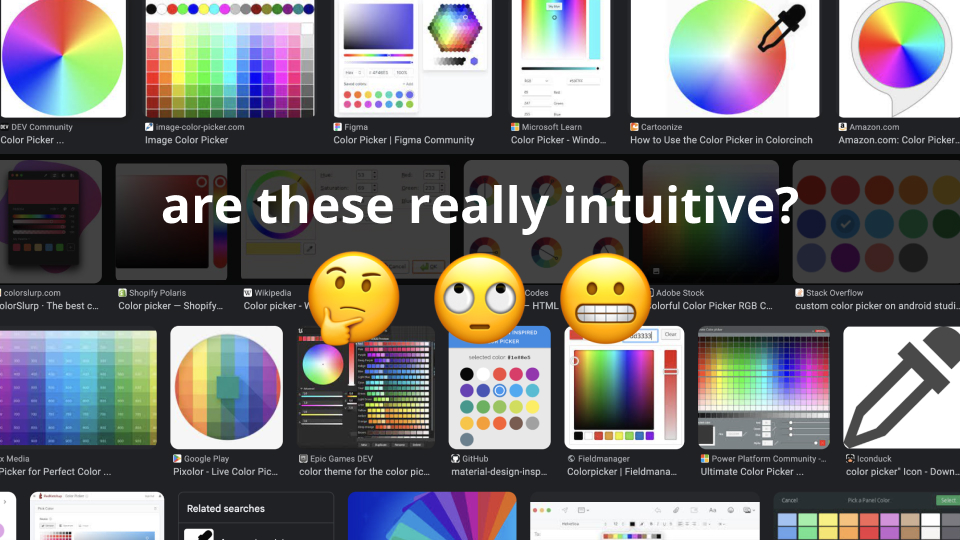
Color pickers: a crayon box with sixteen million crayons
The crayon box taught us how digital color would work before computers existed: the colors come ready-made, you pick the closest one, and mixing isn’t part of the deal. The color picker is that same box, grown to sixteen million colors, with the same limitation still inside.
Every color gets picked alone, in a dialog, separated from the composition where it will actually live. You get no feedback on how it relates to its neighbors, and color is all about relationships.
Then there are the modes. RGB, HSL, CMYK, hex; each with its own logic, none of them explaining when to prefer one over another. Most people switch between them without knowing why. That isn’t flexibility, it’s friction wearing flexibility’s clothes.
And because there is no mixing, the process a painter knows is missing entirely: blending, adjusting by influence, feeling your way toward a color. You never learn how colors are composed, or how to move from one color to another with intention; you try things until something looks right. Sixteen million colors, and the best tool we have for choosing between them is luck.
Palette generators: someone else’s colors
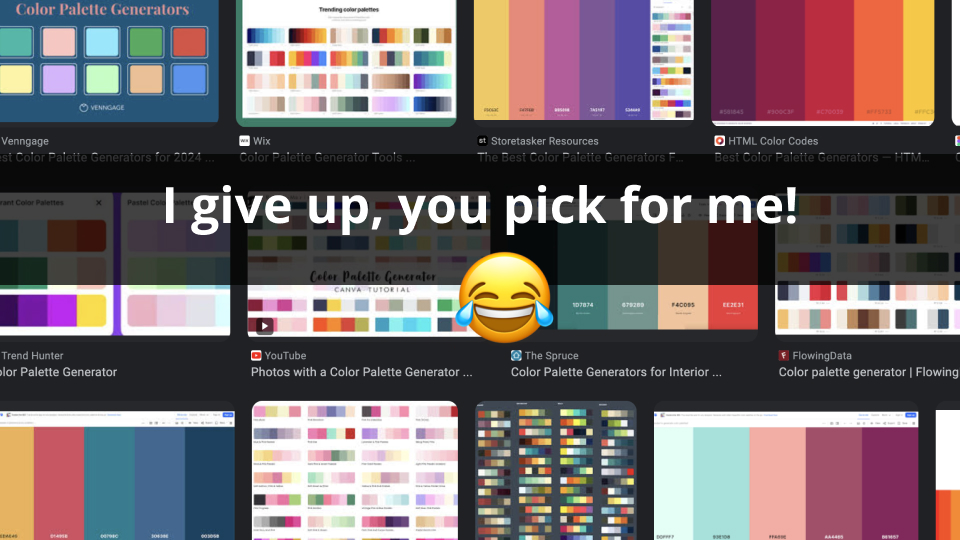
Palette generators promise to rescue you from the picker by choosing your colors for you. They’re quick, they’re colorful, and they leave you exactly where you started: with colors you didn’t create.
The results come from mechanical harmony formulas, and those formulas leave out a lot; enormous territories of valid, vibrant color combinations that no generator will ever hand you. They can look fine in a swatch strip and fall apart in an actual composition.
And when your work develops and the palette needs to grow with it, you’re stuck, because refining color takes exactly the understanding the generator never gave you. Easy answers, but they take away your personal agency with color; and that agency is where all the satisfaction lives.
Color theory: rules where seeing should be
Color theory was supposed to be the foundation under all of this, and for most people it never delivered. Not because the knowledge is wrong, but because of how it reaches you: as rules to memorize. The wheel, the harmony formulas, the named schemes; a system to apply, rather than an eye to develop.
But color doesn’t work like rules; color is relational, alive in the eye, and the eye is trained the way a hand is: through practice. The great teachers of color knew this, and taught hands on, eyes on: experience first, with the principles arriving afterward, as explanations of what your own eyes had already discovered. That’s how colorists are actually made. Theory without that experience leaves you able to recite what should work, and unable to see why it doesn’t.
A better way
None of this is necessary. Mixing can be hands-on and visual. Relationships can be seen in real time, in the composition, as they change. Theory can be learned through the eye instead of the rulebook.
Mixing, not selection. Understanding, not answers. Uniting the hand and the eye. This is Colormxr.